

The Beaujolais Terroir Box: Brouilly & Morgon Legends (5 Bottles)
The Beaujolais Terroir Box: Brouilly & Morgon Legends (5 Bottles)
Couldn't load pickup availability
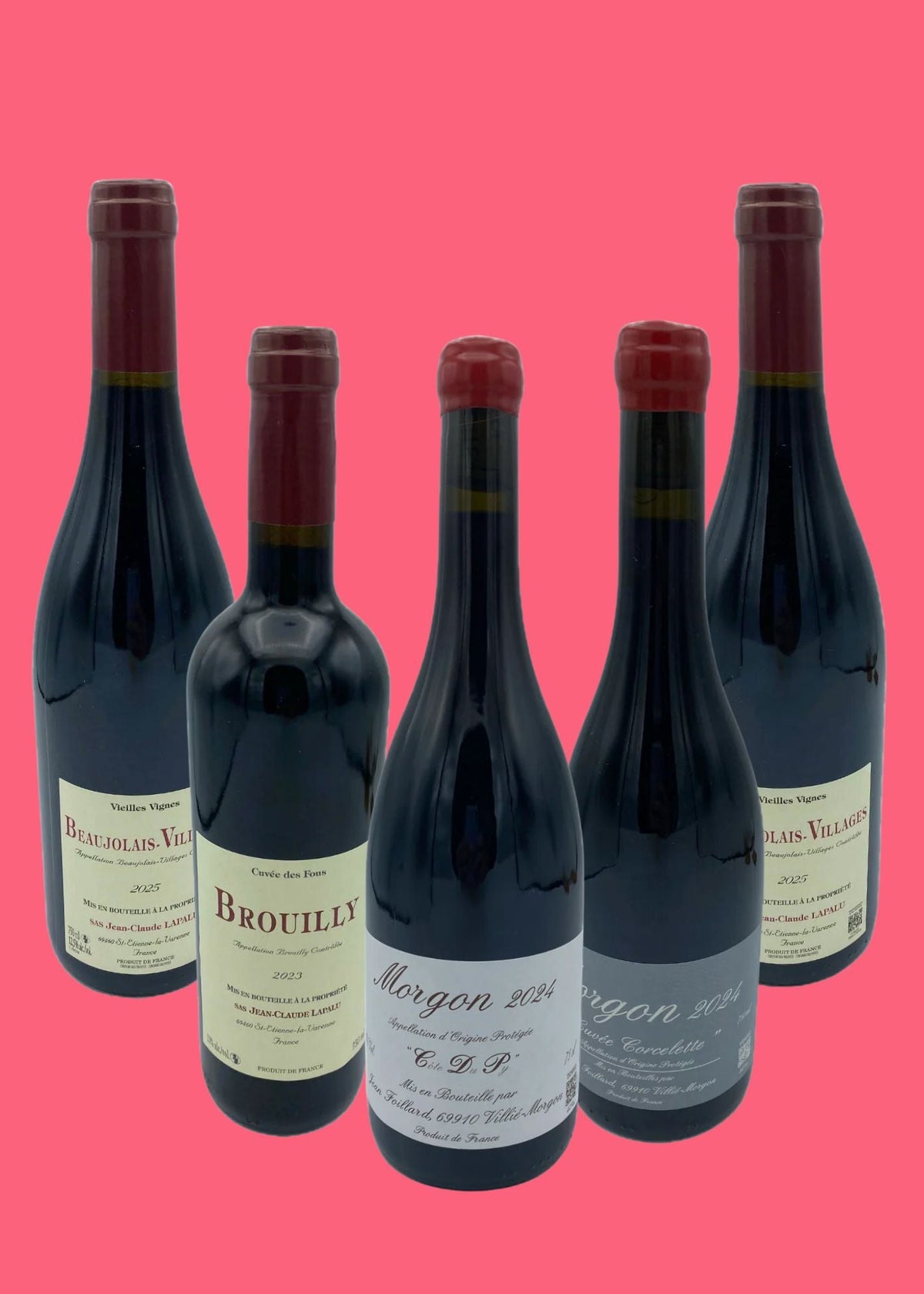
An unmissable lineup for natural wine lovers. Five benchmark bottles from Beaujolais trailblazers Jean-Claude Lapalu and Jean Foillard, spanning vibrant old-vine Beaujolais-Villages to iconic single-vineyard bottlings from Brouilly and Morgon. Pure, expressive, and built to drink now or age gracefully.
In the box of Beaujolais Terroir Box: Brouilly & Morgon Legends:
1 x Lapalu Beaujolais Villages Vieilles Vignes 2025
Juicy, supple and easy to drink. Just the right combination of structure and aromas.
1 x Lapalu Brouilly La Croix des Rameaux 2023
Gamay from old vines. With an incredible balance of fruit, structure and tannins, this wine is made for ageing!
1 x Lapalu Brouilly Cuvée des Fous 2023
Gamay from 100 years old vines. Powerful and supple, with blackcurrant, black olive and fine tannins.
1 x Jean Foillard Morgon Corcelette 2024
Silky and concentrated, with red fruits, violets, earth and spices. This is a very special, single vineyard cuvée from 80-year-old parcel of gnarly old vines rooted into sandstone soils.
1 x Jean Foillard Morgon Cote du Py 2024
Earthy and green notes on the nose at opening then evolve into beautiful layers of red fruits with a creamy, round palate. On the savoury side, with gentle violets and smokey aromas.
Situated in the eastern part of France, just north of Lyon, Beaujolais is renowned for making outstanding reds from the Gamay grape. The granite soils and semi-continental climate contribute to the unique flavour profile of Beaujolais wines. Each of the 10 Crus, that account for the 15% of total production only, offer distinctive wines with different characters.
Share
Organic, Biodynamic and Natural wine. What’s the difference?
To understand this concept and its various ramifications, it is necessary to keep something clear in mind: before the 20th century and the spreading of affordable synthetic fertilisers, all farming was organic. When the shift to the use of synthetics and pesticides happened, it became necessary to diversify traditional organic farming from the new modern farming.
ORGANIC WINE
Simply put, organic farming forbids the use of synthetic fertilisers, synthetic pesticides, herbicides, or genetically modified organisms. The basic requirements are generally specific and engage the farmers not to use any chemical fertilisers and other synthetic products in the vineyard. It does not prevent the vintner from using the conventional winemaking process after harvesting.
BIODYNAMIC WINE
Let’s take organic farming one step further: Biodynamic. The creator of this agricultural system is the Austrian philosopher Rudolf Steiner, who developed the principles of biodynamics in a series of lectures given in 1924 in Germany. Here lies the foundation of true organic wines, with a strict limit in the use of additives, stringent requirements and at the end obtaining a biodynamic certification.
NATURAL WINE
The previous definitions are usually, and rightfully, associated with it, because most natural wine is also organic and/or biodynamic. But not vice versa!
Natural wine is wine in its purest form, simply described as nothing added, nothing taken away, just grapes fermented. No manipulation whatsoever, minimal intervention both in the vineyards and in the winery. Healthy grapes, natural yeast and natural fermentation, with no filtration nor fining. Sounds easy, right? However, making natural wine is unforgiving and it requires a bigger amount of work than conventional wine. To this day, natural wine has no certification yet.