

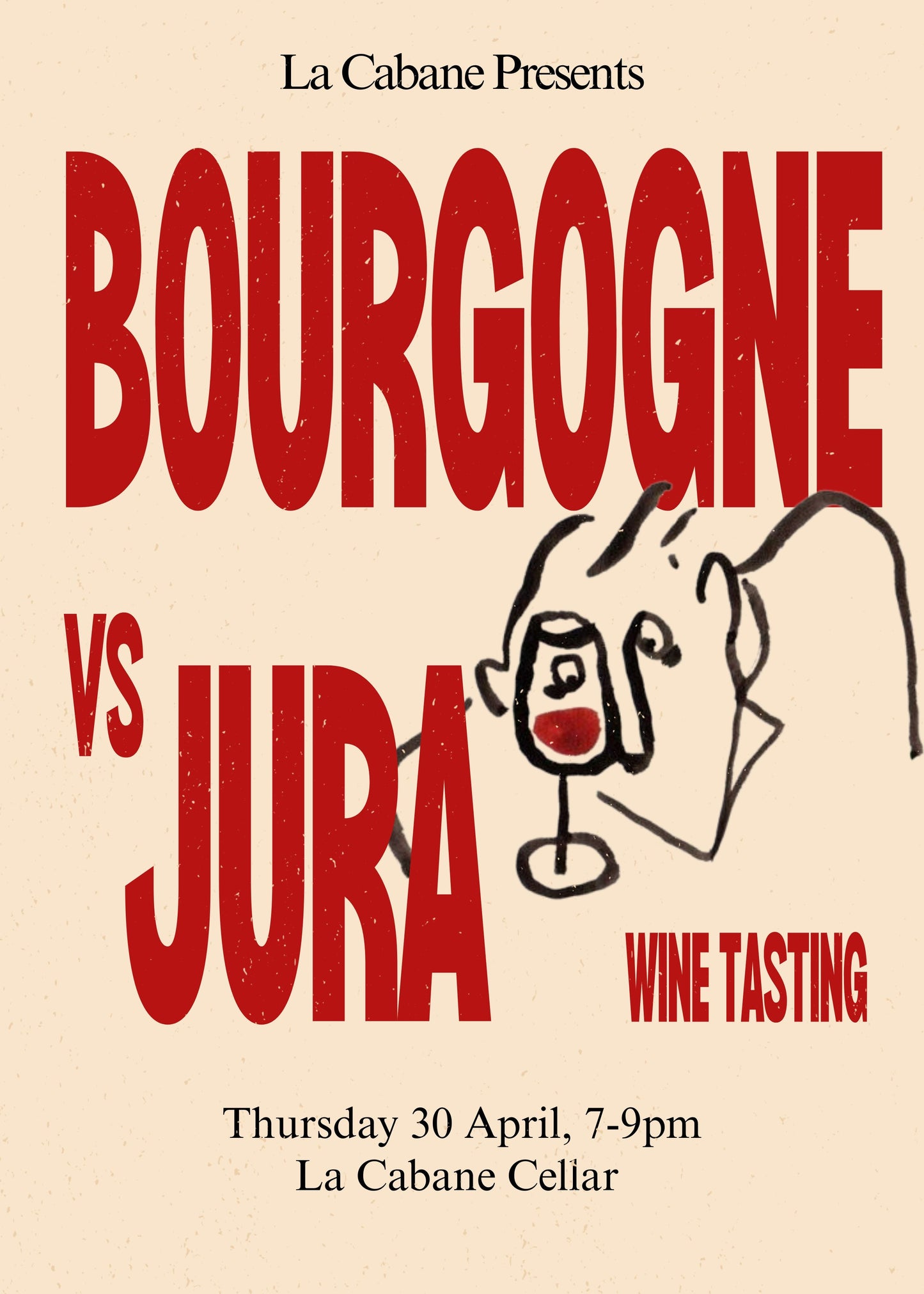
Bourgogne vs Jura: Cellar Tasting 30.04.2026
Bourgogne vs Jura: Cellar Tasting 30.04.2026
Couldn't load pickup availability
Two of France’s most fascinating wine regions, sitting side by side in the east of the country.
Bourgogne is one of the most studied wine regions in the world. A place where tiny vineyard plots, limestone soils, and centuries of observation have turned Pinot Noir and Chardonnay into some of the most precise (and expensive) wines on the planet.
Just next door, Jura. A tiny region with a cult following, and proudly unconventional. Here you’ll find oxidative styles like Vin Jaune, flor-aged wines, and local grapes like Savagnin and Poulsard that have developed a serious following among curious drinkers and wine geeks alike.
Join us for a side-by-side tasting exploring what makes these two iconic regions so special.
What we'll be tasting
Renaud Boyer Saint Romain blanc 2022
De Moor Chablis Bel-Air et Clardy 2023
La Petite Empreinte Mas a Tierra 2024
Les Valseuses Expensive Shit 2022
Valentin Morel En Bois D'Arnoux 2023
Ganevat Domaine Trousseau Plein Sud 2023
Share
Organic, Biodynamic and Natural wine. What’s the difference?
To understand this concept and its various ramifications, it is necessary to keep something clear in mind: before the 20th century and the spreading of affordable synthetic fertilisers, all farming was organic. When the shift to the use of synthetics and pesticides happened, it became necessary to diversify traditional organic farming from the new modern farming.
ORGANIC WINE
Simply put, organic farming forbids the use of synthetic fertilisers, synthetic pesticides, herbicides, or genetically modified organisms. The basic requirements are generally specific and engage the farmers not to use any chemical fertilisers and other synthetic products in the vineyard. It does not prevent the vintner from using the conventional winemaking process after harvesting.
BIODYNAMIC WINE
Let’s take organic farming one step further: Biodynamic. The creator of this agricultural system is the Austrian philosopher Rudolf Steiner, who developed the principles of biodynamics in a series of lectures given in 1924 in Germany. Here lies the foundation of true organic wines, with a strict limit in the use of additives, stringent requirements and at the end obtaining a biodynamic certification.
NATURAL WINE
The previous definitions are usually, and rightfully, associated with it, because most natural wine is also organic and/or biodynamic. But not vice versa!
Natural wine is wine in its purest form, simply described as nothing added, nothing taken away, just grapes fermented. No manipulation whatsoever, minimal intervention both in the vineyards and in the winery. Healthy grapes, natural yeast and natural fermentation, with no filtration nor fining. Sounds easy, right? However, making natural wine is unforgiving and it requires a bigger amount of work than conventional wine. To this day, natural wine has no certification yet.